AC power supply versus AC grid emulation
Although there are similarities and the terms are often used interchangeably, there are clear differences between an AC power supply and an AC grid emulator. An AC power supply is essentially a laboratory power source for alternating voltage. Typical characteristics include:
- 0–300 VAC
- L‑N (adjustable, programmable)
- Single‑phase and/or three‑phase versions
- 40–500 Hz (adjustable, programmable)
- Pure sinewave output
- Low output impedance
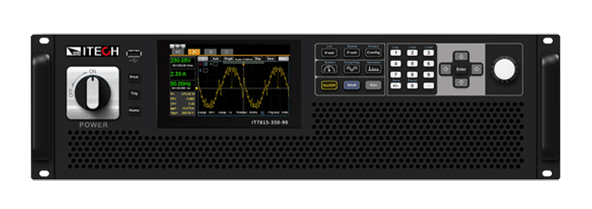
An AC grid emulator is far more advanced. In addition to the functions of an AC power supply, it can reproduce the behaviour of a real electrical grid. This includes:
- voltage sags
- voltage surges
- frequency variations
- harmonic distortion
- phase shifts
- grid‑impedance simulation
- phase imbalance
- fast transients
A grid emulator is often bidirectional, allowing it to absorb power (sink). This is essential for testing equipment that feeds energy back into the grid.
Modern grid emulators are typically built as four‑quadrant amplifiers, enabling them to generate both AC and DC voltages. Many systems can also operate as regenerative AC/DC loads. The programmable output impedance makes it possible to simulate realistic grid conditions—true “real‑world utility grids.”
The latest generation of grid emulators includes standardized test routines such as IEC 61000‑4‑11 / ‑4‑13 / ‑4‑14 / ‑4‑28, and supports specific applications such as anti‑islanding testing. This functionality makes it significantly easier for test engineers to evaluate power‑conversion equipment in accordance with current standards.
Read more on the pages below:

