Testing the effects of grid distortion
Using a grid emulator, you can test the effects of grid distortion. A grid emulator (or programmable AC power supply) is used to test devices as if they were connected to a real power grid, but in a fully controllable, safe, and reproducible manner. A grid emulator simulates the behavior of a real power grid, including:
- mains voltage (e.g., 230V or 400V variations)
- power frequency (50 Hz, 60 Hz variations)
- voltage dips and voltage spikes
- harmonic distortion
- flicker
- DC-offset
- phase imbalance (in a 3-phase system)
- glitches and transients
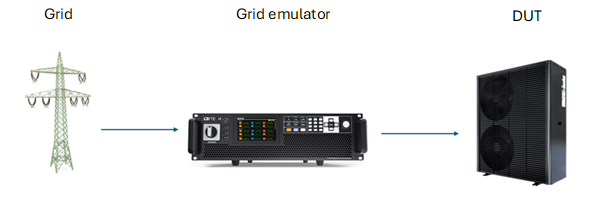
The image above shows a schematic overview of testing a heat pump using a grid emulator. By performing functional tests on the connected equipment (in this case, a heat pump), the device can be tested under various grid conditions. For example:
- Does the voltage drop? → Does the device restart?
- Increasing the harmonics? → Will it overheat?
- Injecting noise → disruptions in communication lines?
An oscillation of 3.5 Hz superimposed on a 50 Hz sine wave (see the figure below) can also be simulated using a grid emulator. This can be generated using the built-in “arbitrary waveform editor.”
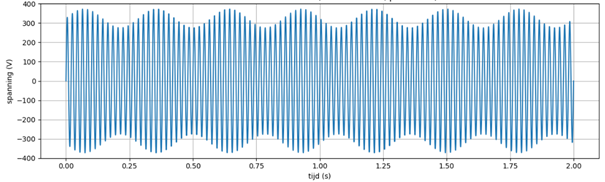
Next, the impact on the connected device can be examined.
If actual local grid conditions need to be simulated, the grid emulator also includes a function for capturing and emulating voltage signals. The grid emulator can function as a data acquisition device and capture voltage variation signals from other instruments. With this feature, users can record the actual grid voltage variations of the device under test and then use the import function to load the captured waveforms into the grid emulator, thereby reproducing the actual grid conditions.
Some grid emulators also function as programmable four-quadrant power amplifiers, making them suitable for testing various grid-connected products such as energy storage systems, microgrids, bidirectional chargers (V2X), and PHiL simulations. So, if the energy flow of an application needs to go in both directions, an amplifier is required that can both source and sink power. This brings us to bidirectional and bipolar, or 4-quadrant, amplifiers.
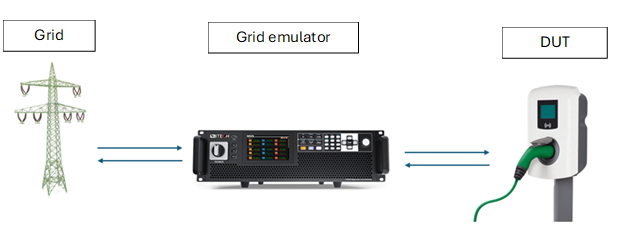
The image above shows a schematic overview of testing a bidirectional charging station using a grid emulator.
In a Power Hardware-in-the-Loop (PHIL) system, the equipment under test (such as an inverter) is integrated into a test setup that includes real-time simulation models of other equipment and systems (such as a power grid or a wind turbine). The entire setup is then controlled by a real-time simulation environment that coordinates and monitors the behavior of the entire system. PHIL offers several advantages over conventional test systems, including a higher degree of safety, accuracy, reproducibility, and flexibility. It also makes it possible to execute the most advanced and complex test scenarios that are difficult to achieve with traditional test methods.
TTMS offers a variety of grid emulators in its product portfolio. For more information, see the link below:
https://tt-ms.com/products/power-en/grid-emulators/
For more information, please visit the pages below.

